
Liquid Manufacturing for Supplement Brands Explained
If you're building a supplement brand, you've probably realized that turning a formula into a bottle on a shelf is a lot more complicated than it sounds. Liquid manufacturing for supplement brands involves sourcing ingredients, blending them accurately, filling them into containers, and getting everything packaged and labeled correctly. Each step has its own set of challenges, and getting them wrong can mean wasted product, missed deadlines, or a batch that doesn't meet quality standards.

TABLE OF CONTENTS
The Basics of Liquid Manufacturing for Supplement Brands
Liquid manufacturing covers everything that happens between a formula on paper and a finished product ready for a customer. That includes mixing raw ingredients in the correct ratios, testing for consistency, filling the liquid into bottles or containers, capping and sealing them, and applying labels. For supplement brands specifically, this often means working with tinctures, functional beverages, syrups, oils, or liquid vitamins, all of which have different viscosities and handling requirements.
The equipment used matters quite a bit here. A liquid filling company that specializes in low-viscosity products might not be the right fit for a thick, oil-based tincture. Temperature control, mixing speed, and the type of pump used during filling can all affect the final product's quality and shelf stability. This is part of why so many supplement founders eventually look outside their own facilities for help, and it's also why choosing the right liquid filler matters more than people expect going in.
The Filling Process Behind Every Bottle
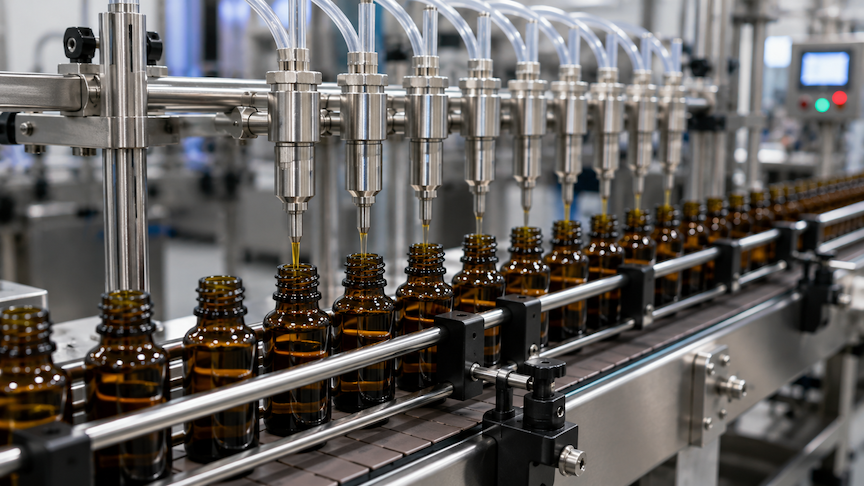
Once a formula is mixed and tested, it moves into the filling stage, and this is where a lot of the technical detail lives. Liquid filling equipment measures out a precise amount of product for each container, and the method used depends on the liquid's thickness and how sensitive the ingredients are to air, heat, or agitation.
Thin liquids, like functional shots or water-based tonics, are usually filled with high-speed volumetric or overflow fillers. Thicker products, such as oils or syrups, often need piston fillers that can handle viscosity without leaving air pockets or inconsistent fill levels. Getting this wrong doesn't just look bad on the shelf, it can also affect dosing accuracy, which matters a great deal for a supplement product.
After filling, containers move through capping, sealing, and often induction sealing for tamper evidence. Labeling comes next, followed by inspection to catch any fill level or seal issues before the product ships. A liquid packaging line that handles all of these steps smoothly, without slowing down or introducing contamination risk, is one of the biggest differentiators between manufacturing partners.
Contract Manufacturing vs Contract Packaging vs Contract Filling
These three terms get used interchangeably a lot, but they actually describe different services, and knowing the difference can save a brand some confusion when reaching out to potential partners. Contract manufacturing typically covers the full production process, from formulation and mixing through filling and packaging. A brand might come in with just an idea, and the contract manufacturer helps develop the formula and produce the finished goods.
Contract filling is more specific. It refers to the actual process of getting the liquid into its container, whether that's a bottle, pouch, or jar. A brand that already has a finished formula might only need contract filling services rather than full manufacturing support.
Contract packaging, sometimes called co-packing, covers what happens after the product is filled, like labeling, boxing, and preparing items for shipment or retail. Some companies offer all three services under one roof, while others specialize in just one part of the process. Understanding which service a brand actually needs helps narrow down the search for the right partner, and it's a good idea to ask any potential filling company exactly where their services start and stop.
White Labeling as One Option Among Many
Not every brand wants to build a formula from the ground up, and that's where white labeling comes in. Instead of developing a recipe in-house, a brand can partner with a manufacturer that already has a proven formula and apply its own label and branding to the finished product. This is one of several white labeling opportunities available to liquid supplement brands choosing white labeling as a faster route to market, since there's no need to test stability or source ingredients independently.
That said, white labeling isn't the only path, and it isn't right for every brand. Some founders start there and later transition to a custom formulation once they understand their customer base better. Others skip it entirely and go straight into full contract manufacturing. According to the National Institutes of Health Office of Dietary Supplements, supplement products marketed in the United States are regulated for labeling accuracy and safety, so brands need to understand these requirements no matter which manufacturing path they choose.
What to Look for in a Liquid Filling Company
Not every liquid filler is equipped to handle every type of product, so it helps to ask a few questions before committing to a partner. First, does the company have experience with your specific product type, whether that's a thin liquid, a thicker tincture, or something with suspended particles that requires special handling. Equipment that works well for water-based products might not perform the same way with an oil-based formula.
It's also worth asking about batch size flexibility. Some liquid packaging operations are built for very large runs and aren't cost-effective for smaller orders, while others specialize in smaller or mid-sized batches that make more sense for a growing brand. Quality certifications matter too. The U.S. Food and Drug Administration outlines current good manufacturing practice requirements for dietary supplements, and a reputable filling company should be able to speak clearly about how they meet these standards.
Finally, consider communication and turnaround time. A filling company that's difficult to reach or vague about timelines can create real headaches down the line, especially if a brand is trying to coordinate a product launch or restock inventory before it runs out.

How Automated Filling Services Supports Supplement Brands
Automated Filling Services works with supplement brands throughout Utah and beyond, offering contract filling, contract packaging, formulation support, and white labeling for liquid products. The team has experience handling a range of viscosities and container types, which means brands don't have to compromise on their formula just to fit a filler's limitations.
Whether a brand is scaling up an existing formula or exploring a new product line, having a manufacturing partner who understands the details of liquid handling makes a meaningful difference in consistency and reliability from batch to batch. If you're evaluating options for your next production run, take a look at what Automated Filling Services offers and reach out to talk through your specific needs and available services.


Comments