
How Automated Filling Systems Adapt to Different Liquid Viscosities
Not every liquid behaves the same way on a filling line, and that's easy to overlook when automation gets talked about as one general capability. A thin, watery cleaning solution moves through equipment completely differently than a thick body butter, and a foaming shampoo base introduces problems neither of those other two products has to deal with. Understanding how automated filling actually adapts to different viscosities and formulation types explains a lot about why some equipment handles a wide range of products well while other setups are much more limited to whatever they were originally built for.

Table of Contents
Why Viscosity Changes Everything About Filling
Viscosity, essentially how thick or thin a liquid is, affects nearly every part of the filling process. It determines how fast a liquid can flow through a nozzle, how much pressure is needed to move it, and how it settles once it's inside a container. A system calibrated for a thin liquid will often underfill or struggle with a thick one, and the reverse is just as true, since equipment built for viscous products can overwhelm and waste a thin, fast-moving liquid that doesn't need nearly as much pressure to dispense.
This is part of why versatility in automated filling isn't really about one machine doing everything. It's about having the right calibration, and sometimes the right equipment entirely, for the specific product being run. A facility that treats every product the same way tends to get inconsistent results the moment a formula falls outside whatever range its default setup was built for.
Thin, Free-Flowing Liquids
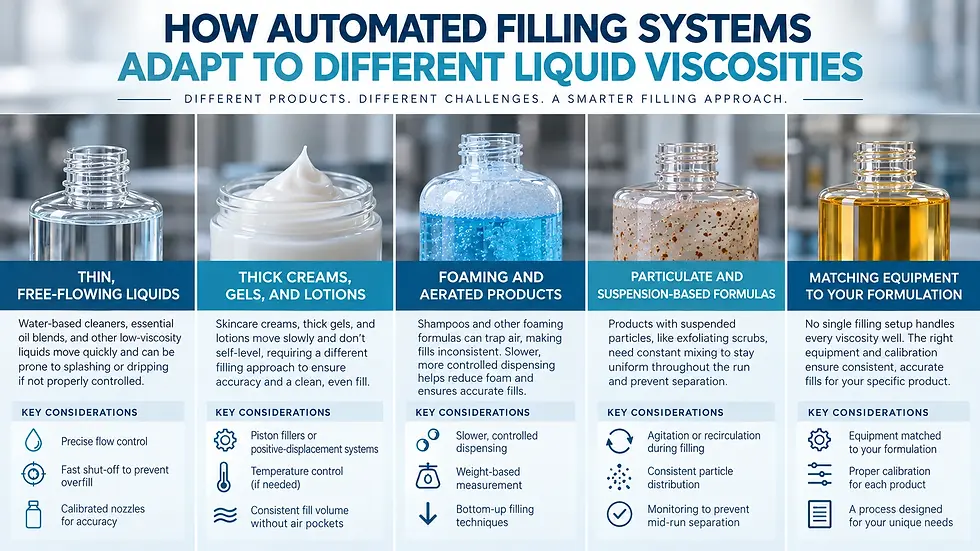
Water-based cleaning solutions, some essential oil blends, and other low-viscosity liquids move quickly and can be prone to splashing or dripping if a filling system isn't calibrated correctly. These products typically need precise flow control and fast shut-off to avoid overfill or drips down the side of a container, since a thin liquid keeps moving even after the dispensing stops unless the equipment accounts for it.
Speed is usually less of a constraint with thin liquids than accuracy is. A line running a low-viscosity product can often move quickly, but only if the equipment is dialed in tightly enough to stop cleanly at the right volume every time. A nozzle that's even slightly out of calibration on a fast-moving liquid can waste a noticeable amount of product over the course of a full production run.
Thick Creams, Gels, and Lotions
Skincare creams, thick gels, and similar products move slowly and don't self-level the way thin liquids do, which changes the entire approach to filling them. Piston fillers or other positive-displacement methods are typically used here, physically pushing product into the container rather than relying on gravity or simple flow control.
Getting an even fill without air pockets matters more with thick products than it does with thin ones, since a lotion or cream doesn't settle to hide an inconsistency the way a thin liquid would. That makes fill accuracy and a clean, even surface a bigger focus for this category than raw speed. Temperature can also play a role here, since some thick formulas need to be kept warm enough to flow properly without changing the product's texture or stability.
Foaming and Aerated Products
Shampoos, some cleansers, and other formulas prone to foaming introduce a challenge that neither thin nor thick liquids typically deal with. Filling too quickly can trap air and create foam, which throws off the fill level and can leave a container looking underfilled even when the actual product weight is correct. Slower, more controlled dispensing, sometimes combined with bottom-up filling techniques that reduce agitation, helps keep foam from becoming a problem.
This category also tends to benefit from weight-based measurement rather than volume alone, since foam can make a volume reading misleading in a way that weight doesn't have the same issue with.
Particulate and Suspension-Based Formulas
Products with suspended particles, like exfoliating scrubs or certain supplement formulas, need to stay evenly mixed throughout the filling process, or the particles can settle and create inconsistent fills from the first container in a batch to the last. Equipment built for these products often includes agitation or recirculation to keep the mixture uniform right up until the moment of filling.
Skipping this step is a common source of inconsistency for products in this category, since a batch that looks uniform at the start of a run can separate noticeably by the time it's most of the way through if the formula isn't kept moving. Catching that kind of drift early matters, since a batch that separates mid-run can produce containers that look fine but don't actually match each other in composition.
Matching Equipment to Your Formulation
The clearest takeaway across all of these categories is that no single filling setup handles every viscosity well. Real versatility across different liquid viscosities means having different equipment, or at least different calibrations, on hand for each type, rather than asking one standardized process to stretch across products it wasn't built for.
That's worth asking about directly when evaluating a filling partner. A provider that can speak specifically to how they'd handle your exact formulation, rather than offering a generic answer about their equipment being versatile, is a much stronger sign that they've actually thought through what your product needs rather than just assuming it will fit their existing setup.

Handling Different Liquid Viscosities at Automated Filling Services
Automated Filling Services works with brands across supplements, cosmetics, cleaning products, essential oils, and household chemicals, calibrating equipment to match each product's specific viscosity and formulation rather than running everything through the same process. The goal is to get an accurate, consistent fill regardless of whether a product is thin and fast-moving or thick and slow to settle.
If you're not sure how your specific formulation would run on a filling line, it's worth a direct conversation about the viscosity, texture, and any special handling your product needs. Automated Filling Services offers contract filling services built around matching the right process to your actual formulation, not a one-size-fits-all setup. Contact us today to learn more.


Comments